Photo Gallery
- Al-Kharabsheh: We are working with the Jordan Chamber of Industry to overcome the challenges facing the industrial sector related to energy costs.
- Al-Kharabsheh stresses the importance of moving towards rationalizing energy consumption, which poses a challenge for some industrialists.
- Al-Kharabsheh: Time-of-use electricity tariffs will be applied to the hotel and healthcare sectors at the beginning of next year to achieve savings and change consumption patterns.
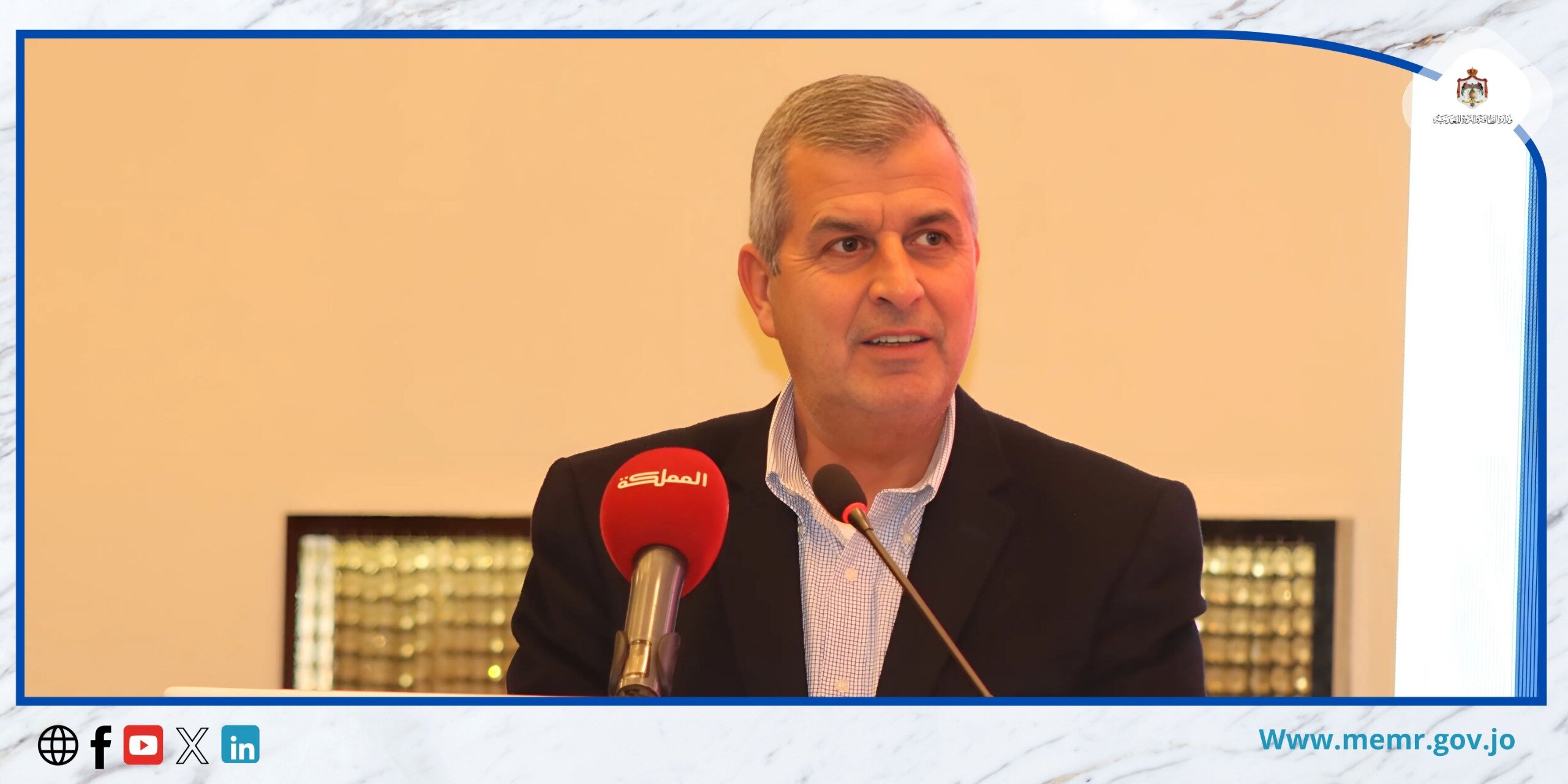
December 11, 2024 – Dr. Saleh Al-Kharabsheh, Minister of Energy and Mineral Resources, sponsored today, Wednesday, the opening of the "Forum on Ways to Enhance Efficiency in the Industrial Sector," organized by the Jordan Chamber of Industry and supported by the U.S. Agency for International Development (USAID).
On the sidelines of the forum's opening, Al-Kharabsheh witnessed the launch of the Energy and Environmental Sustainability Center in Industry and the signing of two agreements: the first between the USAID-funded Energy Sector Support Program and the Jordan Chamber of Industry, and the second between the Jordan Chamber of Industry and the Jordan Kuwait Bank.
In his opening speech, Al-Kharabsheh stated that the Ministry is intensively working with the Jordan Chamber of Industry to overcome the challenges facing the industrial sector regarding energy costs. This is being done through several programs and projects aimed at reducing these costs and improving energy efficiency in the industrial sector, so that it can compete more effectively in regional and global markets, thus contributing more to achieving the goals of the Economic Modernization Vision.
Al-Kharabsheh pointed out that Jordan’s energy intensity index is 20-25% higher than the global average, stressing the need to move towards rationalizing energy consumption, as energy bills present a challenge for some industrialists.
The Minister hopes that the Energy and Environmental Sustainability Center in Industry will contribute to ensuring energy supply security, sustainability, and cost reduction for the sector.
Regarding the time-of-use electricity tariff, Al-Kharabsheh revealed that it will be applied to the hotel and healthcare sectors starting in 2025. He explained that this presents an opportunity to reduce and rationalize consumption by shifting to a different consumption pattern, noting that applying the time-of-use tariff to these sectors will contribute to achieving savings ranging between 10-15% when taking advantage of off-peak hours.
Concerning the delivery of natural gas to industrial areas, Al-Kharabsheh confirmed that the Ministry is continuing to extend gas to industrial clusters across the Kingdom. A measuring station in the Hashmiyeh area will be inaugurated soon, and work is underway to extend gas to the Al-Rawda industrial area in Ma’an Governorate.
He emphasized that providing natural gas to industrial areas will achieve savings of about 30% compared to heavy fuel, 55% compared to liquefied petroleum gas (LPG), and 60% compared to diesel.
For his part, the Vice President of the Jordan Chamber of Industry and President of the Irbid Chamber of Industry, Hani Abu Hassan, stated that government support significantly contributes to strengthening and developing industry to play its role in achieving sustainability and comprehensive development.
Abu Hassan added that the Jordan Chamber of Industry is doing everything possible to achieve the highest rates of transition to a green economy, so that the sector can access new global markets in alignment with the tracks of the Economic Modernization Vision.
He affirmed that the Energy and Environmental Sustainability Center for the industrial sector will support the transition to a green economy, which will solidify Jordan’s position in this framework and enable it to be globally competitive.
Dr. Maher Mahrouq, President of the Jordanian Banks Association, stated that the sustainability of the industrial sector’s activities is directly integrated with sustainability directives in the banking sector in Jordan. This integration guarantees the potential for both sectors to contribute to achieving national sustainability.
Mahrouq stressed that international shifts towards a green economy and sustainability represent a real opportunity for economic sectors to enhance their competitiveness, open new export markets, and build cooperation networks while attracting green investments.
Ahmed Al-Bass, Head of the Energy and Environmental Sustainability Center in the Industrial Sector, explained that the center will serve as a platform bringing together all partners to coordinate work collaboratively, aiming to achieve savings, reduce waste, and lower costs for the industrial sector, ultimately enhancing global competitiveness for local products.
Al-Bass noted that the center’s vision looks forward to developing the industrial sector and creating an integrated platform to manage data related to industrial sector consumption and its rationalization mechanisms.