Photo Gallery
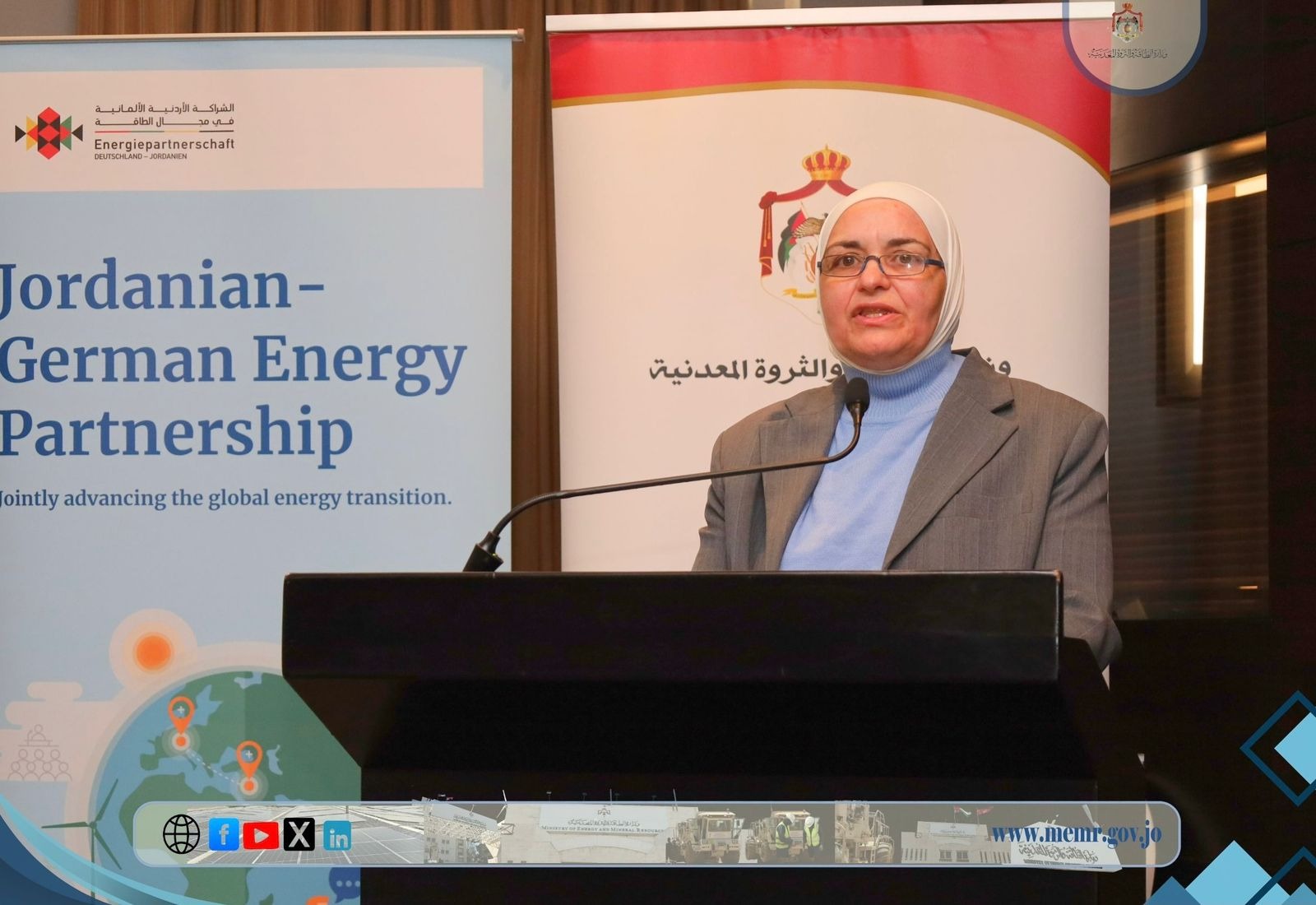
2 December 2025 – The Secretary-General of the Ministry of Energy and Mineral Resources, Eng. Amani Al-Azzam, today, Tuesday, inaugurated the first working group meeting on energy efficiency under the Jordanian–German partnership, with the participation of representatives from government entities, development partners, the private sector, and experts from both countries.
In her opening remarks, Al-Azzam emphasized that enhancing energy efficiency governance and transparency constitutes a fundamental pillar for Jordan’s energy future, in light of growing energy demand and global climate commitments.
She highlighted that Jordan has made tangible progress in the deployment of renewable energy, development of regulatory frameworks, and adoption of innovative demand management approaches, stressing that energy efficiency has become a national economic resource serving households, industry, and the economy.
Al-Azzam underscored that the success of energy efficiency efforts requires a clear governance system, institutional coordination, and active participation from all stakeholders, pointing out that national goals cannot be achieved by a single entity.
She also noted that the establishment of the Energy Efficiency and Climate Change Directorate within the Ministry aims to support policy design, monitor plan implementation, and enhance transparency and participation.
For his part r Ralph Böhme, Director General for External Economic Policy at BMWE, stated that 2025 marked an advanced stage in Jordan-Germany cooperation, noting that 2026 will see a greater focus on energy efficiency and expansion of renewable energy. He added that Germany aims to reduce energy consumption by 26% by 2030 through governance, innovation, and knowledge exchange.
In the same context, Eng. Lina Al Mobaideen, Director of the Energy Efficiency and Climate Change Directorate, explained that the meeting reflects a participatory approach to strengthening governance and national policies in this field, leveraging international experiences, particularly from Germany, to support optimal energy use and improve efficiency across various sectors in Jordan. She emphasized that energy efficiency is a strategic element that enhances energy security, reduces costs, and supports Jordan’s climate commitments.
Regarding the importance of stakeholder dialogue in enhancing trust and transparency, Eng. Kim Lakeit, Head of the Department for International Cooperation at dena,, pointed to the trend toward digitizing sector operations and building databases to support the development of a sustainable national energy efficiency system.